go baby go
Members
-
Joined
-
Last visited
Everything posted by go baby go
-
Towe001 Thanks for the link. intresting setup. I was thinking of having the carbie blow through (in the standard position on the manifold) until I go EFI. I would never run a mixture of fuel and air any further than from the carbie to the piston, I don't like explosions when I'm in them. On a 7K would intresting (more torque to fight lag) but lets blow up the stock motor first. :happy:
-
Thanks for the replys. :laff: Ive just come from owning a JZA80 TT Supra and the cops loved that car. I never got defected just a lot of intrest and this is why I'm still in the mind set that cops will pull me over. I live in a country town and the guys at the the local wrecking yards have no idea about pricing(if is not ford or holden its just rubbish, there words not mine).Finding a turbo and a few other goodies wont be too hard. I have got a set of 5 two piece meshies for $20 each and a set of 4 AME rims for $20 each. Ha Ha I love this town. :dance: It will be intresting to see how much lag is generated, and if the air temp drops on its way from the turbo to the intake. The more i think about it, picking up the air from the rear side vents and running it through a filter and then throuh the floor (in the boot) to the turbo will get me some nice cold air. What are the side vents for in a KE55 anyway? :hmm:
-
Hello to all. this is my first mechanical question....so be gentle. There is a growing trend in the US of removing all mufflers from your car and puting a turbo in the location where the rear muffler was. So I'm thinking about doing this to a ke55 coupe and would just like to get any thoughts from you all. Is this a good idea? will it be to loud with no muffs? Has any one else done this? So heres the plan..... step 1. An exhaust pipe runs to the back of the car and into a turbo 2. Air is drawn in from the rear under the car? I'm a little worried about sucking in water when its wet. another idea is to use the vents in the rear quater panels (with custom grills) as the air intakes feeding the turbo 3. Have the compressed air flow to the engine via a very long intake pipe from the rear of the car to the intake manifold or carbie. 4. Additional oil pump to pump oil from the sump to the turbo and back again ( this may act as a cooler a little). Thats about it. Why do I want to do this? For a few reasons. Stealth install. If a cop looks under the hood and sees a standard looking K motor then they are more inclined to leave you alone. Having a sleaper appeals to me. Will give the car more go. Will keep under bonnet temps down. Will put a little more weight over the rear wheels, And it will be different. Your thoughts will be respected.
-
I had a jza80 twin turbo supra with the standard turbos running around 1 Bar (14.7 psi). This system worked well and you could tell when the larger turbo came on boost.This system is simple, but because I'm lazy I will let toyota say it in there own words. Turbo System consists of 2 turbochargers. See Fig. 2. While No. 1 turbocharger provides boost pressure at low engine RPM and engine load conditions, both turbochargers together provide boost pressure at high engine RPM and engine load conditions. System is equipped with a Charge Air Cooler (CAC) to cool turbocharger intake air. Cooling of turbocharger intake air increases air density, resulting in increased engine output. An intake air control valve is located on No. 2 turbocharger. See Fig. 2. An exhaust by-pass valve and exhaust gas control valve are used in the turbocharger system. See Fig. 3. During low engine RPM, intake air control valve, exhaust gas control valve and wastegate are closed and only No. 1 turbocharger provides boost pressure. When boost pressure reaches a predetermined level, exhaust by-pass valve opens. When exhaust by-pass valve opens, exhaust gas is delivered to No. 2 turbocharger and No. 2 turbocharger operates to provide additional boost pressure. During high engine RPM, exhaust gas control valve and intake air control valve are opened. This allows No. 1 and 2 turbochargers to provide boost pressure. At this time, even if exhaust by-pass valve operates, it cannot affect boost pressure, since it is downstream of No. 2 turbocharger. During high engine RPM, the wastegate controls boost pressure of entire system. The Engine Control Module (ECM) controls the wastegate, exhaust gas control valve and exhaust by-pass valve operation by using a Vacuum Switching Valve (VSV) for each component. The ECM uses various input signals for determining VSV operation. The VSV controls the pressure flow to an actuator for the wastegate, exhaust gas control valve and exhaust by-pass valve. Courtesy of Toyota Motor Sales, U.S.A., Inc. See like I said simple.
-
Yeah I thought a tt 6sp supra was my dream car..... been there done that with 50k of mods but it was not the same. Soon ill be rattling along with with you. :)
-
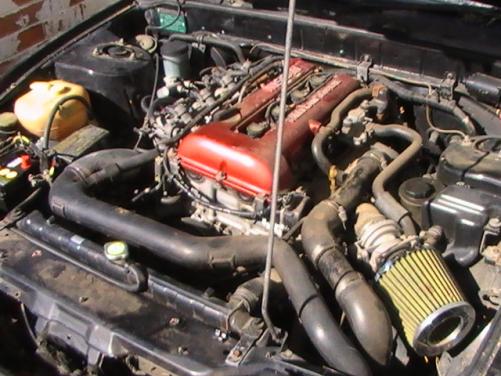
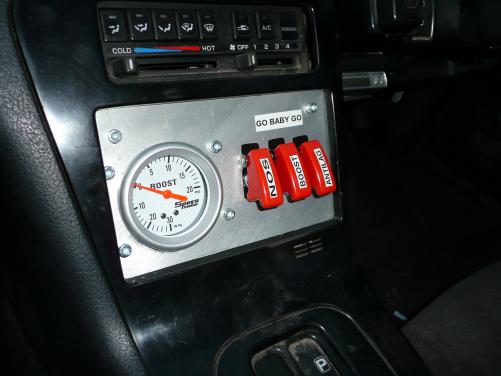
Conversion Package? If your looking to do the sr20det conversion to your rolla this could be it. Engine, computer, wiring harness, brakes, suspension, fuel pump, seats, exhaust, power window setup, dash (gauges), mags ( ok there shit but good for skids), almost everything you need to do the conversion is here. Then sell off the rest to recoupe some cost as its a good shell. Just an Idea Some more pics
-
I paid $900 for my first 55 it ran on three cylinders and had surface rust, then when I took it off the road for an overhall ( 2tg 5spd respray etc) I got a ke10 with stuffed motor for $100 and put the motor in from the 55. Sold them both for a few thou each. I want a 55 now and how much would I pay ????? swap you my 180sx To answer your other question "how long is a piece of string" thats an easy one. Equal distance from the centre.
-
To me this is not about money. Sure who ever buys/ swaps is getting a good deal, and will no doubt get the 180 on the road and make money by selling it. To me the 180sx has no heart because i have no history with it. don't get me wrong when she was on the road the 180 was wicked to drive, but call me crazy the old corolla is what I love. When I was younger I spent alot of time with my old man and a few mates working the old rolla. Some of the best times of my life was working on and driving my rolla, even meet my wife in the coupe. Shit maybe I'm having a mid life crisis???? Anyway its a win win situation as far as I'm conserned. Shame I'm not in Melb caus we would be talking for sure.
-
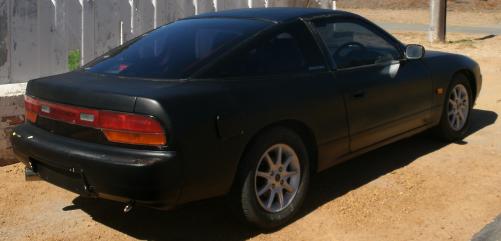
Vehicle information:1989 180sx Condition:used Price:$4000 ono but really want ke55 coupe Location:Geraldton WA Contact: Phone 0448330041, [email protected] 1989 180sx (200sx s13 side windows and rear brake light) sr20det conversion (from ca18det) auto......I know. NO REGO. needs new paint job but I just had the rust done so its primer black which looks tough.Big exhaust, boost gauge heaps of little things done, complete and running. comes with everything to get over pits. I have done most of the work like some after market stuff taken off and stock stuff put on, like fmic and boost controller..... defectable stuff. Comes with spares - hatch,hks boost controller,fmic, full harness seat belts (on car at the mo). I really want a ke55 coupe, as it was my first car :D , and I never got to do all the things I wanted to do to it due to being poor ass student :wub: . now I have the cash the ideas and the skill I just need the car. Even if you think your ke55 is not worth $4000 I don't care we can still swap no cash diff. must have rego and a fair body. Make me an offer...........