


altezzaclub
-
Posts
6815 -
Joined
-
Last visited
-
Days Won
134


altezzaclub's Achievements


-
The magnets were for exactly that Banjo! Usually they bolt on to the crank nose. The starter was starting to get cooked from the lack of clearance to the extractors- So this morning's job was a lower heat shield- ..and the beautiful black-painted milled alloy valley cover met a step-drill for 3 extra holes.. I might start chasing airflow around the engine bay when its running, I can pull air in the side vent which runs inside the guard from beside the passenger's headlight to in front of the turret, taking cold air to the original 4K air filter. Its just awkward going across the engine bay to the valley cover. The starter solution will be to either fit an alloy spacer plate milled from 6mm to 4mm so it tilts the extractors towards the chassis rail, there's 25-30mm clearance there, or Josh reckons cut the pipes off the manifold plate and weld an extra 20mm of pipe in, its faster for him to do that. Electrics tomorrow, everyone's favourite!


-
Well I re-set the timing a few weeks back, drove it around for the day and.. the next day it wouldn't start! Fooled around long enough to flatten the battery, tried to get the timing back where it was on the Haltech, then pulled the dizzy out and stripped it. Decided the VR reluctors from factory might be dodgy so spent a couple of days fitting Banjo's Hall Effect dizzy and the COPs kits, rewiring a bunch of stuff to do it. Of course it still wouldn't start, so I popped out to the workshop and borrowed a compression gauge. Two cyls were crap, so, off with its head! Everything inside was carboned up, and once I had the valves out you could see the gritty soot holding the valve off the seat. The head went off and got dipped, came back looking like new, and I have been slowly putting it back together. This time I did the cam timing quite carefully instead of relying on what it was. The cams are Wade 267deg grinds, nothing outrageous. I didn't spend the time re-making my old dial gauge mounts from Datsun 1600 days, with the cam shims you can simply stick a small screwdriver in the cut-out of the tappet lifter and if the valve is open, you can feel instantly when the cam lifts off and the lifter rotates. Same for when the valve is closed, as you rotate the cam you can rotate the lifter barrel back and forth until it suddenly jams as the cam lobe presses on it. The best buy was the $3 150mm protractor from Officeworks, and I had half a dozen strong little magnets from an ipad I took apart one time. With the head off the pistons come up just clear of the block slightly, so I could check piston travel from both directions just before TDC. Turns out TDC is not where the mark on the cam cover is, its 3deg before that. Not that it will make any difference to setting either cam timing or ignition timing! So they're set up opening at 22deg BTDC and closing 120deg BTDC, and vice versa. I've cleaned up odd things along the way as all the cold start stuff wasn't needed with the Haltech, and now the inlet system is on I'm looking at how close the extractors are to the starter motor. That Subaru fuel filter housing still does a great job as a surge tank! This week I hope to be back on the road!


-
`Ah, another click might be when the starter solenoid engages, throws the gear into the flywheel, but the teeth don't mesh. This comes from the motor usually stopping in the same place when you turn it off, so one small area of teeth on the flywheel get worn out, and the pitch is wrong for the starter motor gear to work & they jam. Sometimes the gears get stuck together and you have to turn the car motor backwards to free them, sometimes they free themselves when you let the key off and maybe start the next try. Its a different, much heavier click to a poor solenoid contact click as the solenoid gear is slamming into the flywheel, so you should see if you can feel or see that gear move.
-
" the starter just clicks." One click per key turn is the solenoid not putting power through, or the starter motor itself. Lots of clicks per key turn is a bad battery. I doubt it is in the key. Pull your spare starter solenoid apart, you will have to unsolder one wire coming out of the metal casing. Inside are two heavy copper contacts, the heads of the bolts where the cables go on. In the main part is a heavy copper bar that slams back and joins one contact to the other. They get burnt away from the sparking due to the 300amps going through them, so clean them up if black and burnt, then put a spring washer under the head of each and put it back in. Now you have pushed them closer to the bar and they should make good contact. https://www.autocornerd.com/where-do-the-wires-go-on-a-starter-solenoid/ "and the fan for the cooling turned on." ...and sort that problem out so it doesn't turn on by itself and flatten the battery.
-
Do you think that was a factory part when the car was new? ..or has someone fitted a European ignition system to it afterwards? If you're lucky its a common Neiman part shared with other cars in the 80s, so you could get a second-hand one in good condition, or a new one from another one-make car club. There are Ferrari ones for sale... Do you know what America used? The column should be the same as yours. Which part do you desperately need, and can you substitute wiring and contacts from generic electrical parts? How's your French? https://mtparts.fr/product-categorie/japanse-tractor-parts/suzue/electrical-parts-suzue/
-
Coil positive is ignition switch, that's where it all gets 12V from. Coil negative goes to distributor and tacho. The condensor joins the coil negative, either outside as in that photo, or inside on the points arm where the black negative wire goes, depends on the dizzy. So is timing set by putting the crank pulley at 10-15deg before TDC for number one cyl, then turning the dizzy until it sparks? ...or put your multimeter across the points and see the voltage change. Grab a cheap timing light when you can, they make life easy. So the plug covered in (fresh I assume?) oil was from the funny K motor 'plug cups' that spill oil down the plug holes when you take them out. So long as they have pretty much the same colour it means the cylinders are working evenly, and a darker one is probably the one that misfires. Try connecting the condensor and checking plugs straight after it misfires and see if you can figure out which cylinder it is. It might be just a plug lead or the distributor cap.
-
Maybe a cold engine problem then- so mixture is weak for cold running, or spark weak when cold and harder to fire. The condensor must be connected for it to run, it builds up a charge of electricity when the points are open and discharges it all at once when the points close, and that rush of power is the thing that fires the coil's high-tension side. The important thing is that the condensor and 12v wire from the coil -ve both go onto the points spring strap, and are insulated from the motor. You can pull the points open with your finger and see how bad the contact surfaces are, the sparking causes spark-erosion on one side and it hollows out, and the other side gets a volcano built up on it as the metal is spark-deposited. That gives a false reading on feeler gauges if you are setting the points gap on old points. When you fit new points, fit a new condensor too, as they lose their insulation strength over time and cause misfires... So check the condensor is connected, that there is no circuit from the moving points arm to earth when the points are open and the key is off, and the points gap is correct and so is the timing. Pull the spark plugs and see if all four are the same colour, maybe you have a dud cylinder. Then check the choke operation, which hopefully is a manual cable. Fully off when off, fully on when on. When it misfires next time you're driving, pull the choke on slowly and see if 1/4 choke helps, or 1/2 choke. Then you will know its lean when cold. If you have a leaking inlet gasket you should see different colours on the plug concerned, that could also make it miss when cold. See how you go- do you do your own tuning? ...so you have feeler gauges or a dwell meter, a timing light and a multimeter for testing circuits?

-
Three questions- What have you done to solve it so far? Stock ignition system? Points and condenser? Does it use water at all? Leaking head gasket will make it misfire when cold, but so can a few other things. Could it be a fault in the choke system rather than a spark misfire?
-

Toyota Corolla Ke70/Te71 Bootlid
altezzaclub replied to Corolla-Boy's topic in KExx Corolla Discussion
See how you go. Because they are a cam hinge they are slotted at each end, allowing the plate to slide along the hinge pin. If you get stuck for making it work I can try to measure the slots at each end, although you can probably just work from the ratio to the 30mm width. -
Pull it out... A painful job,but you'll need it on the bench unless you can measure the voltage at the gauges by lying under the dash. This is a KE70 cluster diagram, I don't know how different it is. ..and the whole diagram for a KE70. There must be KE55 wiring diagrams somewhere on the net, but most web pages saying they have diagrams are pretty dodgy for some reason. The answer may be in here- https://www.youtube.com/watch?v=BI0R9KrMyqg Good luck- If you get stuck PM Banjo, he has one and he is the electrical guru around here.


-
Toyota Corolla Ke70/Te71 Bootlid
altezzaclub replied to Corolla-Boy's topic in KExx Corolla Discussion
The plates are 80mm long x 23mmwide, neatly pressed from a flat maybe 30mm wide to roll the edges for strength. Open slot one end, closed slot on the pin end. Not an easy shape to make. -
Toyota Corolla Ke70/Te71 Bootlid
altezzaclub replied to Corolla-Boy's topic in KExx Corolla Discussion
The usual torsion bar spring used in the 70s.. and the other side... They can be quite grunty springs when you try and fit them!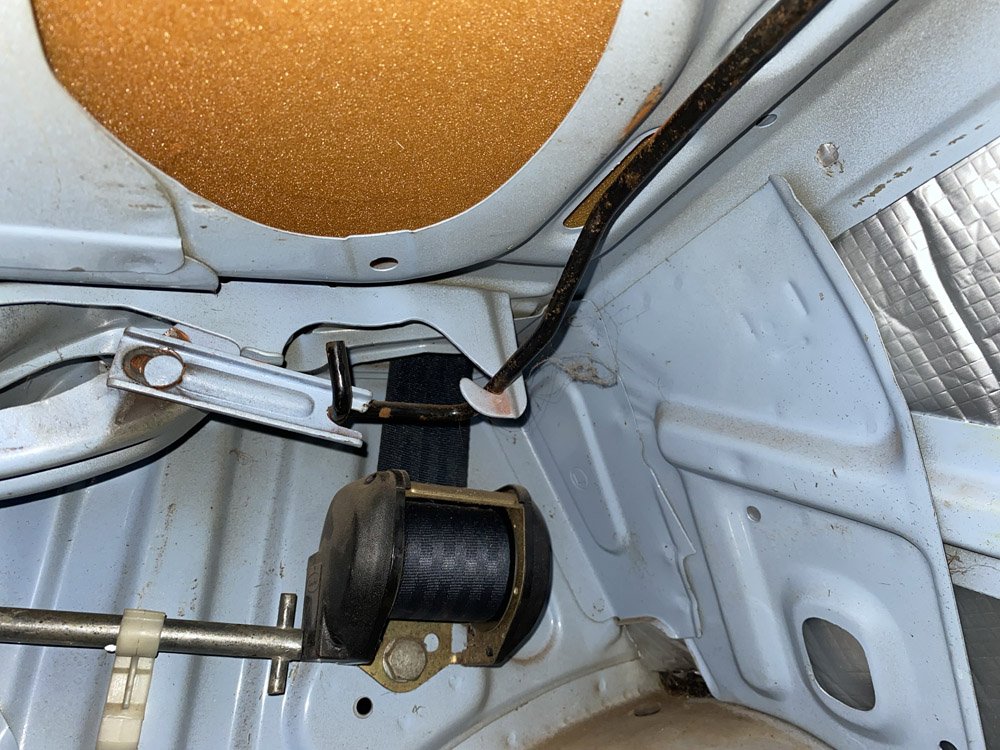
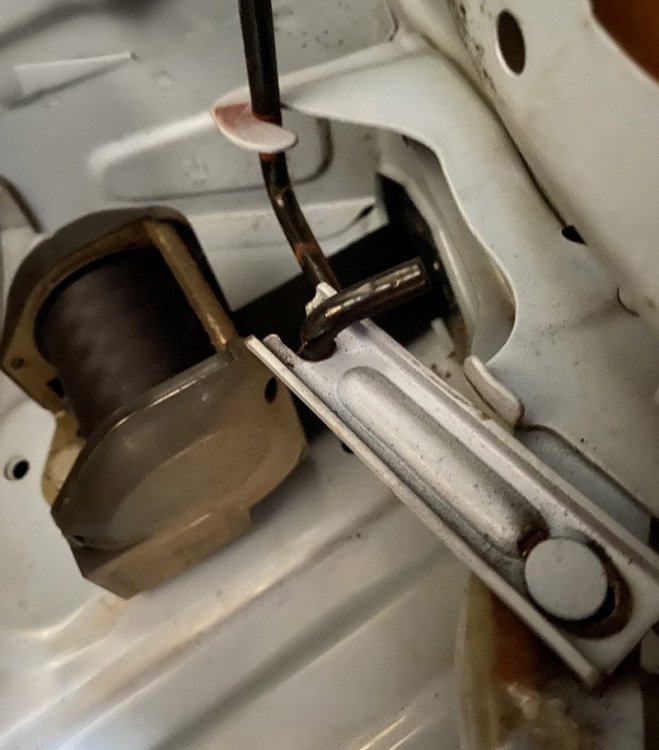
-
No, no IAC on 4AGEs, just the air bleed screw. So a combination of air bleed volume, fuel supply when cold and ignition timing to stop it running away when warm. Having ground cams makes a smooth idle unlikely, and idle injection timing has an effect there. Wiping out the cells below 10% has smoothed it over, and dropping the 'pump jet' and zero-fuel over run completely has also helped. Now you can sit in one cell at 100kph and change throttle for a slight hill, up or down, and the mixture changes anywhere from low 14s to mid-15s without it moving out of that cell. After all, there is 9% throttle in that one cell, and cruise at 100kph is only 6%. The pump jet, otherwise known as extra injection under some conditions, was probably the culprit for the power hitting too hard after a tenth of a second delay. The motor saw a lean mixture as the throttle opened slightly, then a rich mixture straight away after. The bang of acceleration was giving the gearbox and diff a hard time, probably exacerbated by the very light flywheel. The zero injection on over-run meant no fuel at all until the revs dropped to a set speed, say 1500rpm for an idle of 1100. So the motor would be lean at 2000rpm as I slowed from 100kph to 60, then as I eased on the throttle it went from no fuel to too much fuel instantly. So those changes have smoothed the clang as the power hits, made it easier to drive away when cold, and maybe reduced the jerking as throttle is applied, but the next factor will be to see what its done to fuel consumption over a couple of tanks. The idle is fine, cold or hot, its like any car with cams, but the cam grumpiness is what shakes the car when a touch of throttle is applied. TPS gets calibrated every month or two, it moves off zero now and then. I've run it with 'zero' both below the idle voltage, and above so it doesn't reach idle at different times. I can watch the advance on the laptop on the passengers seat, and record it on a drive. It jumps up and down alongside the rpm when the car jerks, but I'm not worrying about that anymore until after I change dizzys.
-
This happened last month- Other than that... more tuning, I cut the 2-10% columns out of the fuel map, thinking the ECU can just work out what it needs to be without so much micromanagement. I think it makes the fuel mix more variable, looking on the wide-band. It settles down in a steady state but can read rich or lean initially after throttle movement. When I get some time I'll change the dizzy to the one that Banjo built, and fit the COPs, just to see what differences that brings.

-
What a difference! " I got a bit disenfranchised by being a terrible welder. " Josh, who does immaculate welding on the roll cages we build, used to say "I'm an average welder,but a very good grinder".. Keep at it!




