


altezzaclub
-
Posts
6828 -
Joined
-
Last visited
-
Days Won
134
Content Type
Profiles
Forums
Events
Gallery
Blogs
Everything posted by altezzaclub
-
I used Crow for mine, there are a few big names for cams in Aussie. Tighe, Crow, Crane, Wade, Waggott. If you get lift over 0.4" you will need to change the valve springs, under that the stock ones are OK. Send the followers away as well & get them ground so the new cam has new followers to wear to. What else are you going to do?? The cam by itself won't do much.
-
Save up & pay cash... Best bargaining power you will ever have, pulling out a handful of $50 notes that is carefully worked out to be 15% less than they want and saying "Awww... this is all I'v got, is that enough.." Paying off a loan is usally 3 times the cash price overall.
-

How To Fix Your Brand-New Ke Motorsport Electronic Distributor
altezzaclub replied to altezzaclub's topic in Car Electrical
I've wondered about that, but I think its pretty normal. Most cars have 20"mercury on the manifold vac, but with a hot cam, SUs and small tappet gaps mine is only 10-12 at idle. So I think a stock setup on ported vac probably gets more vac advance at cruise throttle. I found the car needed more advance than 8deg when it was stock to really make it work, and the stock curve seems very flat compared to other cars. Maybe its all to do with emission control stuff. Yeah, someone should try changing the springs in a stock Bosch setup and see if it improves it. The vac advance only exists when you have a throttle closed or close to that, so all acceleration is done on the mechanical curve only. -
Use the KE70, a far superior rear suspension & handling package. First choice would be a RWD configured 4AGE. Don't worry about the supercharger, the 4AGE will provide plenty of fun without extra problems. If not, I would go 3SGE. Get the whole Altezza 3SGE motor and the 6speed gearbox & fit to the KE70. A front cut would be best for sensors and computers. or if neither of those, then a FWD 4AGE and turn it around. Easiest motor to get, but more work to convert it.
-
Yep!! Start with that- both float levels set correctly, then check all the jets are the same and clean. Make sure the dizzy cap is clean and good, and timing set where it should be. It would be embarassing to spend hours on the carb and find the dizzy cap shorting out through a dirt crack.. Same if you finally found they were running two different sets of jets! Then get the airflow the same and lastly the mixture. You can listen through a tube, or buy an airflow meter, but if you get the meter make sure you listen as well. Easy when you've done it a few times and they are great carbs! I'd love to come and help, my palms get itchy when I hear Webers on full throttle... They should sound like this- http://www.youtube.com/watch?v=5ZV_Uw_UnNg
-
The dizzy is sorted and running well, with the story all here- http://www.rollaclub...594#entry511594 Now its running smoothly I'll just try to tweak the needles the last little bit. The advance curve went from here to there and the car came alive!

-
Well- The vac guage showed that empty revs do not tell you anything about vac advance!! Once we were driving the vac guage (on the manifold) showed around 12"mercury at idle, dropping to zero on acceleration, and maybe coming back to 5 to 10 for cruise. That is a very low vac signal for the dizzy, the Pintara has 18" at idle and Rob reckons his VK Commy has 30 odd! So the piles of advance at higher revs were just a product of high air flow at tiny throttle openings. It takes almost no throttle to run up 3000rpm in the garage, so the manifold vac stays high and adds 10deg to the timing. On the open road it needs a greater throttle opening to get to 3000rpm, so the manifold vacuum is much less. Lesson learnt, all timing shall be done with vac disconnected! (it also showed that my PCV works well and shuts off at idle, like it should!)
-
X2 If you lock the rears it would be most unusual for it not to slew sideways.
-
no you didn't- you cut it on two 45deg angles!! :laff: Easy enough to cut with tinsnips, and Clarkes have a few options. Some of the other rubber sections for the Datsun I bought from Rare Spares.
-
Wind the idle speed up a little when its really warm. The choke may be only raising the revs for the first half, then it richens it as you pull it out more. That's how I've set mine up. Idle speed drops as the motor gets warm, well, mine does anyway but that's on SU carbs...
-
How To Fix Your Brand-New Ke Motorsport Electronic Distributor
altezzaclub replied to altezzaclub's topic in Car Electrical
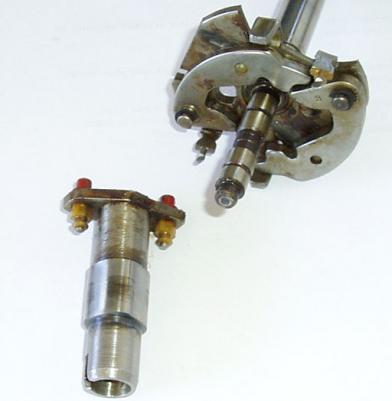
Here's the mechanical Bosch the KE70 came with, and the ND electronic insides. They won't swap anything between them. The Bosch spring rates are 38 and 133, the NDs are both 50ish
-
Pathetic... well, my one was. But it can be sorted- http://www.rollaclub...585#entry511585
-
How To Fix Your Brand-New Ke Motorsport Electronic Distributor
altezzaclub replied to altezzaclub's topic in Car Electrical
It definately runs smoother low down, where twin carbs and ground cams struggle a little... getting off the lean burn of deceleration or driving cold in the morning. The plug gaps can get a bit larger and the spark is greater. Changing points never worried me, the odd misfire was a pain especially as I run it pretty lean, down around 17-20 with foot off. Evan, the weights are quite different, in fact I don't think any of the shaft/plates/weights/springs would interchange. -
How To Fix Your Brand-New Ke Motorsport Electronic Distributor
altezzaclub replied to altezzaclub's topic in Car Electrical
So, I went from two springs at a rate of 50 each to one at a rate of 20. That's what makes these dizzys work! Now I have the advantage of no misfiring at lean mixtures slugging out of a left turn intersection, no rich misfires in the morning, AND it gets up and goes smoothly and sweetly straight over 5000rpm, all on 95octane 10% ethanol. Orange is at 2500ft, so sea level might need a couple of degrees less. I'm afraid I can't tell you what spring to buy, it was .03" wire, wound to 0.23" diameter and I used about 8coils. Here's the sprngs I have left over- the ballpoint is in the top middle, the dizzys (Bosch & KEmotorsport) at the bottom. Three days work and education, or $75+post to Performance Ignition in Melbourne.... :laff:
-
How To Fix Your Brand-New Ke Motorsport Electronic Distributor
altezzaclub replied to altezzaclub's topic in Car Electrical
But the graph only showed a 2degree increase at 1500rpm. I tried the ballpoint by itself, thinking it would max out straight away, but it only went to 28deg... WTF?? Then I realised that although the ballpoint spring held the weights in nicely when I looked at it, when it was running at 1000rpm and I set the timing to 10degrees, the weights had moved out & it was already well into the advance curve, so there wasn't enough movement left to get to 36deg. So, ballpoint spring out and I went to the place where all small springs can be found.. the workshop windowsill. It is a well-known phenomena world-wide that small springs roll away in the dead of night and crawl to the workshop windowsill to hide amongst all the odd bits and pieces thrown on there! I gathered up the half-dozen who had made it that far and measured them. For those who were still pissed from the night before when the lecturer explained coil spring rates, all you need is the wire diameter, the springs outside diameter, and the number of free coils (don't count the end ones) Then look up this website, or any like it- http://www.pontiacracing.net/js_coil_spring_rate.htm The nice thing is you can cut a spring to the number of coils that gives the rate you want.... within reason! So, my stock spring had a rate of 53, my ballpoint spring a rate of 6.5 !! The stock Bosch springs were 38 and 133, and my other springs were 20, 49 and 5. I picked the 20, which was slightly tapered down its length, cut it to calculated length and fitted it. It was just tight at zero revs and generated an even better curve. So we were almost there, just not quite as fast as a Piper. The final trick was to take the stretched stock spring out and just run the taper spring... POW! all the advance in by 3000.

-
How To Fix Your Brand-New Ke Motorsport Electronic Distributor
altezzaclub replied to altezzaclub's topic in Car Electrical
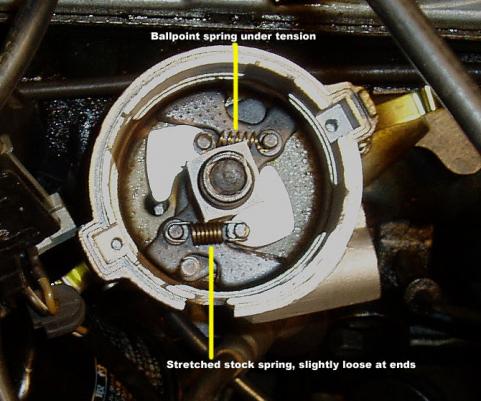
OK, first up I ran it with one spring- definately better but not advancing low down anywhere near enough. Then I measured the length of the springs and stretched one from 21.5mm to 22.9mm. This was done in a few careful stretches and measures, and once I had it too long I bent the end circles in a whisker to get under 23mm. This allows the weights to move out easily low down but the spring slows the advance from half-way onwards. Then, to make sure the weights returned at idle, I fitted a ball-point pen spring to the other side. All looked good-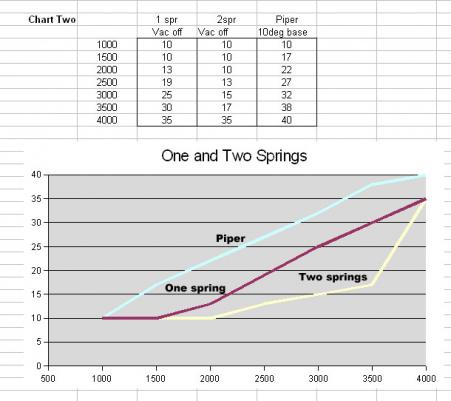
-
How To Fix Your Brand-New Ke Motorsport Electronic Distributor
altezzaclub replied to altezzaclub's topic in Car Electrical
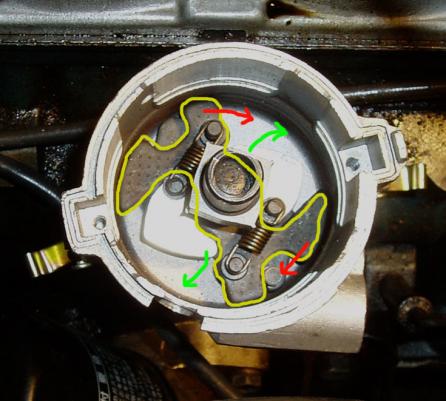
Now you can see the two boomerang-shaped weights and the springs that they work on. There is no need to take anything else out apart from those two springs. You can see that as the weights get flung out by the revs they push the rotor shaft plate around and the max advance slot moves past that pin. When the pin reaches the other side of the slot there is no more advance available. The rotor shaft plate has a strange shape as outlined.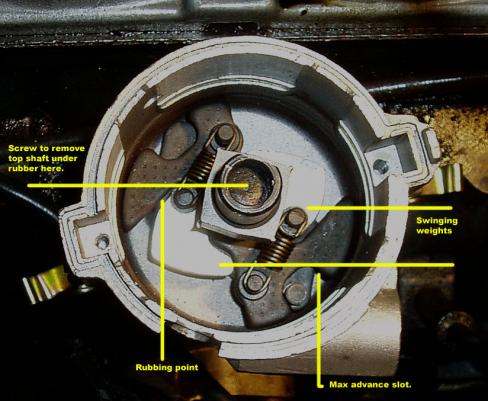
-
How To Fix Your Brand-New Ke Motorsport Electronic Distributor
altezzaclub replied to altezzaclub's topic in Car Electrical
Initially I took the sensor off the rotating baseplate, then I realised there is no need to. Just take out the screws holding down the whole base.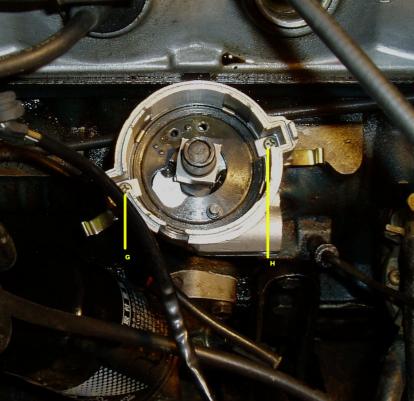
-
How To Fix Your Brand-New Ke Motorsport Electronic Distributor
altezzaclub replied to altezzaclub's topic in Car Electrical
Next is the vac unit, the screw marked C and the circlip marked D. (which I suppose I should put back on now...) That is all that holds the rotating base plate in place and you might need to rotate it to remove the arm.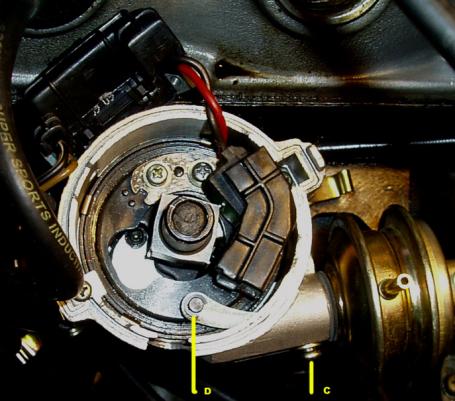
-
How To Fix Your Brand-New Ke Motorsport Electronic Distributor
altezzaclub replied to altezzaclub's topic in Car Electrical
Having got a curve I figured it was time to see what was inside. Taking off the top, the first screws out are marked here. They hold in an electronic unit I assume is the ignitor. Make sure you start this on a clean concrete floor with good light, because over the many times I pulled this thing apart I dropped washers or screws twice, and they took ages to find!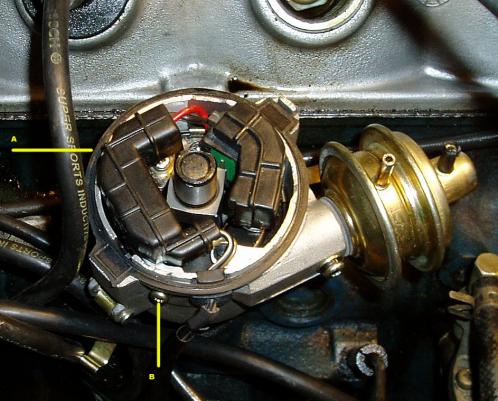
-
So... I went and bought a KE Motorsport electronic dizzy, read up about it and fitted it. 10minutes work! Two wires, vac advance on, check idle timing... done! How to do it is here- http://www.rollaclub...70/page__st__45 Jumped in, drove away, and...... it was a DOG under 3000rpm. Even after that it wasn't fast... So I stopped and wound on some advance, tried it, added advance, tried it, did it again. When I got home I put a timing light on it, and it was running 18deg at idle!! Research time- read some topics here on Rollaclub & it appears they are for HiAce vans! Time to find out what is wrong- First up, I put the timing mark on the crank pulley back at the 20deg mark on the cam cover and white-marked the pulley rim forward every 5degrees. Then I put the last mark back at 20deg & repeated, so now I had a pulley marked every 5degrees out to 40deg. I got the wife to sit inside and give me 500rpm at a time while I read the timing light, and I repeated it with the vac advance hose off. This is the curve it generated, and you can see it has no advance under 3500 worth talking about. The Piper dizzy is a sports distributor with a similar curve to a 1980s Prelude, and I thought that would be a reasonable comparison. What I thought from this was that the port vac figures were crazy. Anyone in the class know what this shows?? The boy in the corner.... Yes, it shows that you don't read vac advance by revving a motor in the garage! Go to the top of the class! A quick drive with a vac gauge showed 12"Hg just off idle, falling off the moment I drove away, & coming back when I lifted off the throttle on over-run. So all work was done without the vac advance.


-
I'd agree Snot, you need more advance the more revs you use, but I assume the guy who locked it knew what he was doing. With giant compression at low revs it must burn pretty fast, but if its knocking already there is no use in giving it 20deg at 2000rpm. Maybe its dieseling! The first compression-ignition rolla!!
-
Yep Give me an hour to do the write-up, and I will explain how to make the useless bloody thing work properly too!! Now it doesn't feel like a van!! :laff:
-
Nsw Rta Stops Registerng Imports.
altezzaclub replied to altezzaclub's topic in Automotive Discussion
Is the yellow plate the VIN sticker trd?? I bought the Altezza with me and it didn't need engineering at all (according to NSW RTA) but I had to get a VIN sticker and a $35 rego inspection. The difference might be that I was an immigrant coming in, and you are allowed to bring a car with you once in your life providing you have owned it and driven it for at least a year in your home country. The lady next door had the Z registered in Darwin for years, it seems to be a problem of bringing a currently unregistered import into NSW. She should have it sorted by Tbursday. -
I've got a pair of Commodore oxy sensors in mine, VT I think, one reading each SU. How about making a needle out of a suitable nail, so it gives you an idle and 2 statons or so. It would only need to stick out 10 or 12mm, then no needle at all. That would tell you if the jet will ever flow enough fuel. With 10deg it shouldn't be pre-ignition causing the knocking- how about octane booster?? Toss in some toluol or xylene to get it running and tuned.


