

Banjo
Regular Member
-
Joined
-
Last visited
Everything posted by Banjo
-
Hi Jeremy, I'd be more concerned with the primary resistance/impedance, than the secondary resistance. The secondary resistance basically only controls the maximum Kilo Volts you get out of the coil. The very low primary resistance of 0.5 ohms, is known as a High Energy or HEI type coil. These low impedance coils are not suitable for use with a 4K electronic dizzy with an internal ignitor. It might work initially, but will eventually burn the ignitor out. The Toyota Yellow Bible gives specs. for the coil primary for use with a 4K dizzy with internal ignitor as minimum 1.3 to 1.6 ohms. A coil with 0.5 ohm will eventually kill it. A fellow RollaClub member had this problem, just 2 weeks ago, which I had a look at. Brand new 4K electronic dizzy from ebay & a HEI coil. Ran for several months then, "no start". Diagnosed ignitor stuffed. Saved dizzy, by removing internal ignitor, & connected the reluctor pickup to the original ignitor wires out to the coil. Fitted a genuine external Bosch BIM-024 ignotor, and back in business. However, to be on the safe side, replaced coil with a GT40 which has a higher primary resistance than the HEI coil that killed the ignitor. I have intended to write a piece for the forum about the importance of matching coil specs to ignitor specs. There are a lot of people out there, that don't fully understand how important this is, is you want outright reliability. Basically the coil primary resistance determines the maximum current that can flow into the coil, whilst it is charging. So Ohms Law says I = E/R If the Volts are 13.5 & the resistance of the coil is 0.5 ohm, then I = 13.5/0.5 = 27 amperes. Ignitors come in various specs, one of which is the maximum DC amperes it can switch. I've seen various ignitor specs ranging from, 3A, 6A, 10A, 16A, & 19A max. Switching those sorts of current generates heat in the ignitor, so cooling them and having good airflow over them, is important for long term reliability. Heatsinks are important. I don't know specifically what the max. amperes the 4K dizzy with internal ignitor can handle. Its not in the manual, & doesn't appear on any website I have come across. They just provide a resistance range for the associated coil primary. So if we assume 1.3 ohms as spec'd, & assume a nominal voltage of 12 volts, then R = 12/1.3 = 9.0 amperes. Be very careful with this one, as it is so easy to lose an ignitor. There are "smart" ignitors, that prevent the ignitor from charging the coil, once the coil has reached saturation. I'm playing with some "smart" Toyota COPs at present, which do just that, but I can assure you the ignitor in the olde 4K electronic dizzy, has no such feature, like that. Cheers Banjo
-
Hi Guys, i note that Rare Spares have a new website, where it is easier to find bits they have, for our Corollas. There are several pages thereof. https://www.rarespares.net.au/beta/rarespares/search?q=corolla&page=0 Cheers Banjo
-
Hi Madelaine, There is nothing like a good long country run, to allow any gremlins to surface, in an olde engine. You said, "she only overheated twice". What were the driving conditions during when there was these two occurrences ? Going up over a range or mountain ? Stuck behind a big truck ? Forced to drive in a lower gear ? The circumstances might give us an idea of what it might be going on. As she ran fine most of the time, I would tend to discount the horrible head scenario. Inspection of spark plugs directly after a run, will usually indicate whether water has entered a cylinder, with a very clean plug, in the offending cylinder. If it was me, I'd be removing the thermostat for the day, & see if that makes a difference. If it was a 35 deg C day, it should not make any difference, as I would expect the thermostat to be open most of the time under those conditions. Removal of thermostat is an easy 10 min. job. Just check the specs of the radiator cap, usually stamped into the metal, on top. Even relatively new thermostats have been known to fail. My guess is the run has loosened some crapp inside the engine, & it has created a blockage somewhere, "throttling" the flow of coolant. My other best guess, is a partially blocked radiator, that has enough flow to run under normal conditions, but not enough to handle an extreme day. Maybe just take the bottom hose off, and put a hose in the top spout. Turn the tap on full, and check the radiator gets it all through to the bottom. If the radiator overflows at the intake at top, it may indicate a reduced flow, due to partial blockage, or build up internally. Cleaner, run, then flush, could fix it, but the safer bet is to get a radiator shop to check & flush, or give it a core clean. Lets know what you find. P.S. I assume, you have checked the fan belt tension. Does your dash temp guage work OK ? Was it running hi all day, without going into the red zone, when she was running fine ? Cheers Banjo
-
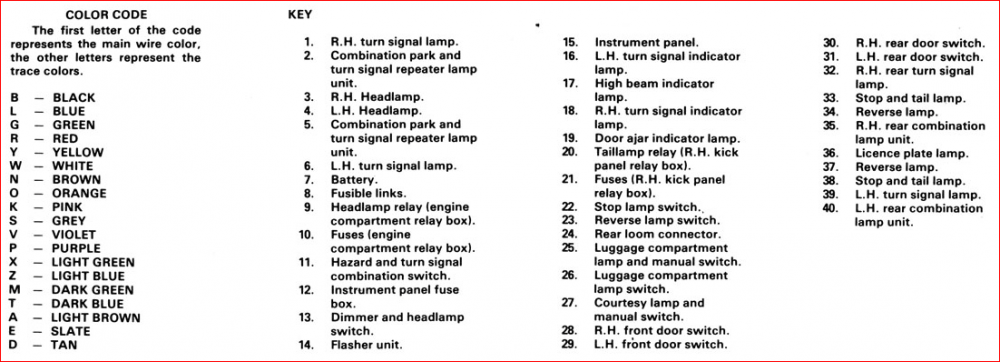
Found this wiring diagram on the net. It is for AE71 lamps only. https://rollaclub.nyc3.digitaloceanspaces.com/monthly_08_2014/post-7544-0-45827600-1407715211.jpg Here is the "legend" for the wiring diagram. Cheers Banjo
-
They are brushes, not bushes. A bush is a bearing in an alternator context, where a brush is something that "brushes" as it slides/rubs on the slip ring. If you tell your auto sparkie you need new bushes, he'll quote you quite differently, than for fitting new brushes. Brush change/replacement is easy, as long as the slip rings are in good nick & haven't gone slightly oval. Cheers Banjo
-
Aftermarket extractors have an advantage that they are separate from the inlet manifold, & pull up to the head independently. However, the flange tips of the inlet manifold & extractors can be different depths, making it difficult to get a thick washer to pull down firmly, & parallel to the head. You could probably grind down the thicker flange tip on the outside to match. If you have a standard setup, then the inlet & exhaust manifolds are bolted together, with 4 off bolts. If you can loosen these slightly (good luck), then pull the manifolds up to the head, (without gasket) then tighten the 4 off bolts holding the manifolds together. Remove the manifolds from the head, & they should now be in the same plane, across the mounting faces. The problem with this suggestion is that the 4 off bolts will be so tight in the threaded section, (which is in the exhaust manifold), that they will break off, whilst trying to undo them, & then you have the need to drill them out & retap them. Cheers Banjo
-
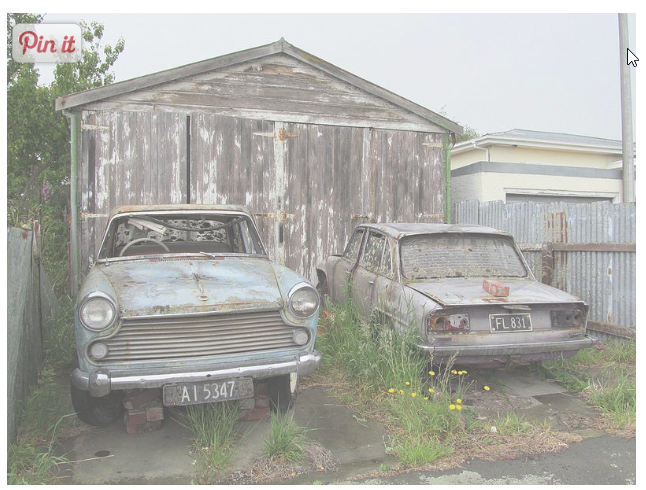
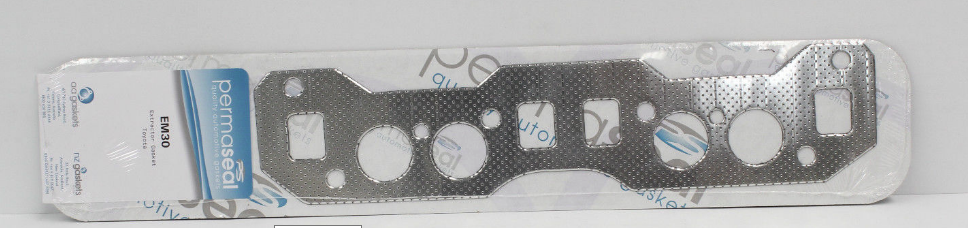
Are Timaru ! In another life, I once owned a Triumph 2500PI (Petrol Injection). Great car ! I can still remember the first time I ever visited N.Z. Just couldn't get over the number of British Cars ! Now, it Japanese second hand imports. P.S. ebay link for 1 piece composite K series manifold gaskets. https://www.ebay.com.au/itm/1974-1978-For-Toyota-Corolla-KE30-3K-3K-H-Extractor-Manifold-Gasket-/201510257673?hash=item2eeaf28409 From the Rollaclub Tech Pages: Exhaust Manifold The stock exhaust manifold is alright if you're just playing around trying to get your car running nicely. There are two types of stock manifold, one has just one outlet pipe, the other has two pipes and is similar to tri-y (4-2-1) extractors. Generally, as you add a larger cam, you need to have tuned length extractors and a larger exhaust in place, or all the extra air your engine is now moving is too much for the stock manifold to hold, and the exhaust gases pulse back up against the inlet charge and fuel comes back in a fine mist out of the carburettor. Any extractors will do, new ones are about $280. You can pick second hand ones up for $50-$100, or sometimes even free if you're lucky like me. Second hand extractors tend to be a pest, in that either the middle pipe has bent out and doesn't like to seal, or the end pipe (usually the rear) is bent from a poorly hung exhaust pulling on it for so many years, and is hard to line up with the head. I've always used second hand extractors which I got for free, and by far the best thing you can do to make the manifold easy to locate and seal is use studs and nuts instead of bolts. This also puts a more even force over the threads of the head, so you're less likely to strip a thread. The normal two-piece manifold gasket can also cause sealing problems if the middle pipe is bent, but an exhaust shop should be able to sell you a one-piece extractor gasket which is much better. You can get metal ones which are alright, but I like the floppy asbestos type gaskets which are difficult to get these days. If your manifold gasket just won't seal, there's a chance the flanges of the inlet manifold and exhaust manifold (or extractors if you're using them) are different thicknesses. Any engine builder or machine shop should be able to grind the faces of the manifolds together for you, to ensure they're flat and sealing properly. This should cost you between $40 and $80. _____________________________________________________________________________________________________________________________________________________________] PERASEAL do a one piece gasket, which has the P/N EM30, available through Bursons here in Australia. I've used them on all my Rollas, & have never had a manifold issue since. Cheers Banjo

-
Your alternator is one with an inbuilt regulator. (that grey plastic bit on the back of the alternator). Only 2 screws to remove to take it off, after disconnecting the battery. Brush assembly & regulator are all one piece. Easy to remove & inspect. Brushes are easy to replace. With the regulator removed, have a look inside the hole, if possible, & take a look at the condition of the slip rings. A quick turn with a bit of 400 wet & dry emery paper will usually have them shiny again. P.S. I did it once on the side of the road. Brushes were worn. Stretched the springs a bit & put it back together again. Got me home OK. Cheers Banjo
-
If you've got bolts holding your manifolds to the head, it is a good idea to replace them with studs & nuts. whilst doing that, also get a one piece manifold gasket. That will get rid of any manifold issues for a long while. P.S. Timaru NZ; nice place, I've been there once. Cheers Banjo
-
.Most likely the brushes on the slip rings have got to the end of their life and are not making constsnt contact with the slip rings occssionally. Easy fix. Cheers Banjo
-
Hi Jeremy, You might want to look at something like this, if you've got a good flat straight road nearby. http://www.ddisoftware.com/ttdyno/ Cheers Banjo
-
Hi Jeremy, I'll dig some stuff out, in the next day or so, that has worked for me, on my KE30 2 door, with a relatively stock 4K-U engine. Cheers Banjo
-
http:// 4 cylinder cars have famously un balaced motors with resonant vibration problems, so hence the term buzz box My kids when they were small, got driven to school and back each day, by my wife in her KE55 Coupe. The kids nick-name for the KE-55 was "BUZZIE" ! Say no more. Cheers Banjo
-
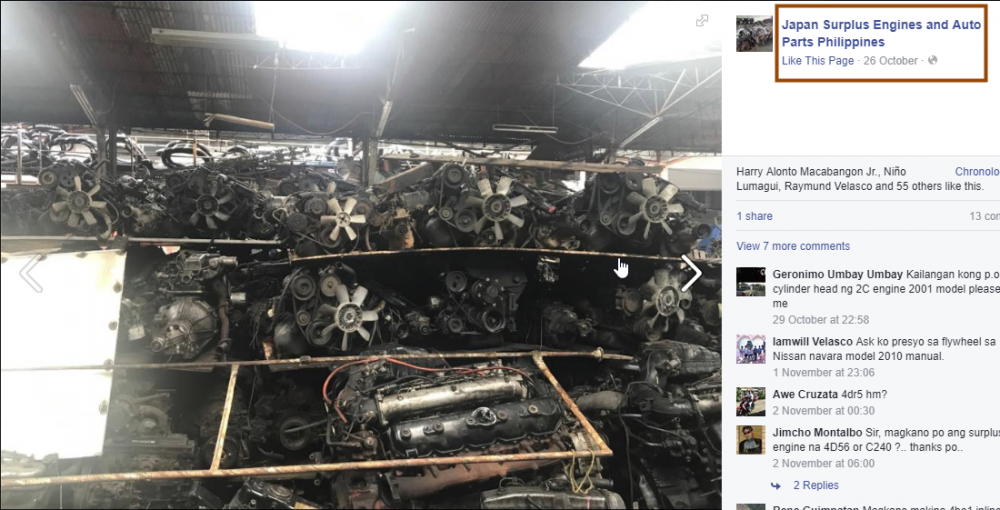
Yikes ! Sounds like Cavite could be a good holiday destination for serious Rollaclub members next year. Take 2 empty suitcases & fill them up. Found 7 things to do whilst in Cavite. https://trip101.com/article/things-to-do-cavite-city-philippines Maybe they should add an 8th thing to do. 8. Pick up some cheap 4K parts for your Rolla back in Ozz ! SPOT THE 4K & WIN A FREE TRIP TO CAVITE FOR CHRISTMAS ! Love it. Cheers Banjo
-
Hi Jeremy, Just checked out your video of the Jeep. I can see your problem right away. You forgot to put your suitcase in the second boot / trunk there in front of the radiator. What the Hell ! Do they put straight 6 cylinder engines in these "jeeps" also ? Cheers Banjo
-
That's insane ! I've never heard anything like that in all my Rollas over many years. My Jacuzzi with a party going on, doesn't even make that much noise. There is something seriously wrong inside that engine. Can't believe all that noise, is caused by a a 0.5 liter of air trapped somewhere inside the block. That's serious cavitation, like when a outboard motor propellor is lifted part way out of the water. Cheers Banjo
-
Hi Jeremy, Nice thongs ! We should probably point out to others looking at your post pics, that the long reach plug is only suitable for the 4K-U engine, & not other 4K variations like the common 4K-C. The long reach plug is only used where dished pistons are utilised. How about a few pics of your "jeep". Cheers Banjo
-
Chassis earths are such a pain in our old Rollas. A good hour taking all the earth lugs off, cleaning them up, & then reconnecting can pick up some lost volts very easily. Pay special attention to the big ones between engine & chassis.
-
Good advice from Altezzaclub there Max. I've saved a few senders by taking it out of the tank & bending the arms a bit. When they get that olde, and have been up & down so many times between empty & full, the pivots also wear, but nothing much you can do about that. As for not reading Full, then read my post regarding that exact issue. https://www.rollaclub.com/board/topic/73224-that-pesky-little-guage-voltage-regulator/ Cheers Banjo
-
Thanks Ian, Fixed that above. Got them around the wrong way ! I just went & checked my original post, where I got it around the right way. Cheers Banjo
-
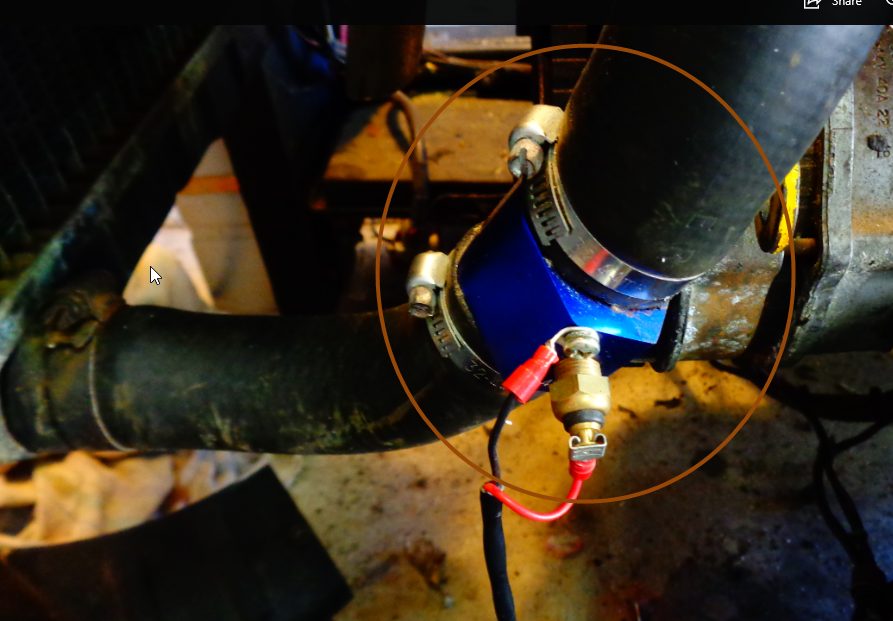
I thought we had finished with this one, but there is the risk, that talking about coolants, & their effects on different engines, from different eras, with different evolutions of the automotive engine cooling system, we could well confuse some readers or researchers, in relation to the K series engine. Strangely enough, the Toyota Yellow bible 2K - 5K manual, only has 8 pages on the cooling system, & 2 off them on electric radiator fans. I'll go through the manual & pick out pieces of information/specs, at the back of the bible, that are relevant to the cooling system & put them up here for future reference, so watch this space. We can describe info & experiences, regarding the cooling system, that only relates to the K Series engine. The K Series, having a cast iron block & an aluminium head, can suffer seriously, if there is any acidity in the coolant fluid. Two different metals, & an acidic fluid between them (electrolyte) creates a battery; currents flow & metal moves . . . you get the picture. On my daily drive KE30, & on my test bed engine, I have a temperature sensor adaptor hooked into the bottom radiator hose. Isolated from the engine like this, via the rubber hose, it is fast reacting, as there is little "heat sink" effect. I have a temperature data logger, where I can record the temperature of both the sensor shown above & the engine temp sensor up on the side of the thermostat housing. The results of these two sensors, graphed together over a drive, show clearly the operation of the cooling system, and whether it is working as it should. I once added a third sensor in front of the grilled which indicated so clearly when the car was moving & when it was stopped at the lights etc. An ambient sensor in the data logger itself, helps relate all the stored readings to outside temperature, & lets you see its effect on the cooling. I'll see if I can't dig out my graphs & pop them up here later. In the meantime, here is a very interesting promotional video, from someone you will recognise, which touches on many of the things "cooling/coolant" that have been discussed here in this post in the past day or so. https://www.youtube.com/watch?v=t7PykrgzWPQ Cheers Banjo
-
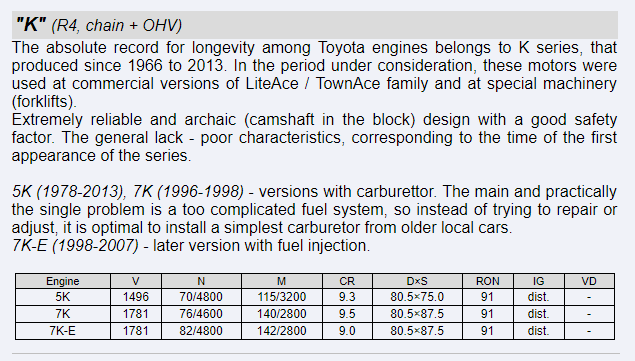
Actually, I accidentally came across a site yesterday, which lists the history of Toyota engines in Russia; and basically says, that even the poorest Toyota designed engine, was better than any of the home grown local Russia offerings. http://toyota-club.net/files/faq/03-08-16_engine_eng.htm I was tickled to read what the article had to say about the K series engine. I was also staggered to read that K Series engines were used in Russia right up to 2013, which is only 4 years ago. I then quickly realised that they were talking about the 5K & 7K engines, which were apparently used in commercial Toyotas like the LiteAce & TownAce. Maybe "Clapped Out" would like a holiday in Russia, & could bring back a couple of 5Ks, as excess baggage ! I love the line "Extremely reliable & archaic design". To my knowledge, & from what I have read, the 5K was still used by Toyota, here in Australia, for their petrol forklifts, up until about the year 2000. Someone who works for Toyota may be able to verify this; but I was told recently, you can still buy a 5K short engine from Toyota here in Australia, off the shelf, as a replacement spare part. I recently posted my interest in the 2NZ-FE series, fitted to the Starlets/Echo/Yaris Toyotas. This engine is amazing. Great design, light, reliable, economical, long life etc. etc. I was looking at it, as a possible replacement to the K Series, when they are gone or banned, by legislation. They are the same 1.3L as the 4K, but pump out twice the HP, in standard form. The 1NZ-FE fitted to the Sportivo models, is a 1.5 litre in same basic block. Unfortunately, it is an east west engine, & could be a pain to mount into a KE Series Rolla. However, I'm prepared to look at it, so if any one knows of a cheap, wrecked, or broken 1NZ-FE engine floating around in Brisbane, or nearby, I'm interested. P.S. My daughter's 2004 Echo has the 2NZ-FE in it, but I don't think she would be too happy about me whipping it out for a week or so, so I can strip & see if it is possible to add different engine mounts to it somehow. Cheers Banjo
-
. . . . . . . . . And to think this little discussion started because poor Luke thought his oil pump had "karcked" it ! Hope you are not too confused now Luke; & please let us know, if it sorted out your "burbling" noise ! Sorry we all hijacked your post. Cheers Banjo P.S. I'm off to bed now, after filling my hot water bottle with Glycol, so there is a 50:50 chance of getting a good nights sleep.
-
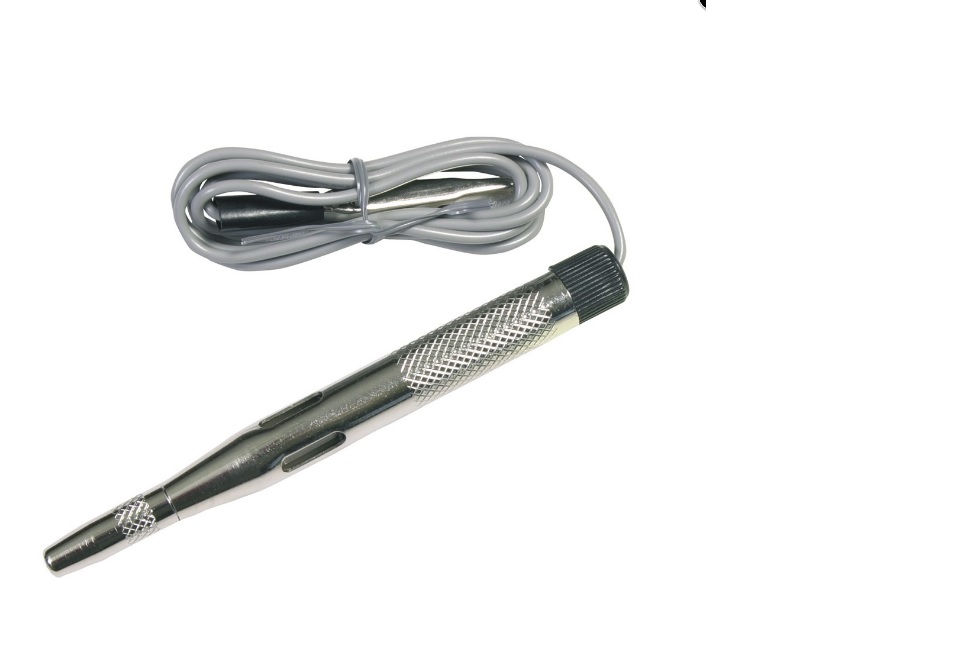
That dropbox wiring diagram file is nice & clear when you blow it up. Excellent ! Thanks Keith. I have drawn for you, just the stop light/brake circuit. It couldn't be simpler, as it is powered all the time, & doesn't pass through the ignition, or other switches. See how simple it looks, when you separate it from all the other circuits. Get yourself a automotive tester probe (< $ 10 at SCA) and connect the alligator clip to the chassis somewhere. Then start at the positive battery terminal & the bulb will light, (assuming the battery -ve to chassis connection is fine) Then move along the circuit, in a clockwise direction, at each side of the fusible link; either side of the 15A fuse; and the "powered" side of the footbrake switch. If you have "light" up to there, check the other side of the switch, with the brake pedal down. If still OK, then get someone to hold the brake pedal down, or bridge or s/c the switch out, and move along to the two LH & RH bulbs in the boot. If still OK, but still no break lights, then either both bulbs are blown, or the chassis connection of the rear light clusters is o/c. With that approach, you must find/discover the problem. You never know, in doing so, you may be lucky, and also solve the other gauge light issues, if it's a common earthing/chassis connection or the like. If that solves your brake lights, then approach the other guage light & turn indicators in the same manner, after drawing out their individual circuits. If you need any more help, just give us a yell. I'm quite aware, how hard it is to follow those auto wiring diagrams, but it really is quite simple, once you break it down to an individual circuit. Cheers Banjo

-
Hi Jeremy, I will try your technique & see if it is possible to get 0.5 extra litres into my cooling system. I'll even run the front wheels up on the ramp, to give the water pump the best chance of purging out those pesky air pockets in the top of the head, when I rev it up. I'll let you know the result. In very old cars, which were designed & built with screw on radiator caps, without pressure relief valves incorporated, their manuals always suggested only filling the radiator up to "an inch below the neck", to allow room for the expansion, rather than run the risk of bursting the old fabric/rubber hoses. The air in the coolant system, then allowed for the coolant's expansion. They had springs in the lower radiator hose also, to stop them collapsing when the water cooled & created a vacuum. Have a read of the following discussion, & especially the varied "comments" at the end. http://www.onallcylinders.com/2016/07/21/9-cooling-system-myths-and-mistakes-and-why-to-avoid-them/ There are those that believe that removing the thermostat, as you have done, actually results in the engine overheating. Lots of food for thought there, & a good read ! P.S. I'd never lead you astray deliberately. Cheers Banjo


