

GJM85
Regular Member
-
Joined
-
Last visited
Everything posted by GJM85
-
The classic jap vehicles are harder to restore. Quality replacement parts are almost impossible to source. We've all seen the ebay crud from Honk Kong. So it means parts must be restored by hand or customised to get the quality finish. This is expensive. For muscle cars, the market is huge and there are heaps of suppliers of quality replacement parts at home and abroad. That competitive market means parts are are reasonably affordable and easy to acquire. It is definitely harder to restore a Japanese classic to a high quality. The problem is they're not as fast or eye catching as a big American muscle car.
-
Cheers mate, that was real help getting the wiring sorted. So I spent last night and today rewiring the loom and fitting the Denso alternator. I used starter cable as the charge wire from 'B' pole & linked it to the starter motor. I ran some 15 amp wire from the battery for 'E' pole, I used the red/white tracer from the original loom as the ignition source for 'N' pole & I used the yellow/white tracer from the loom for the charge light 'L' pole. Well it all seemed good at the battery getting 14.2v at idle but the charge light stayed on. So I checked the wiring again, checked the wiring diagram and checked everything else again. Second go. This time no charge light with ignition on, engine not running. I fired it up, 14.2v all good, I gave it a rev, 17v and not dropping. ʞ©$ɟ. Alternator is throwing sparks.... Shut her down. I'm guessing that the voltage regulator is fooked and is allowing current to earth into the body because that bitch got hot. It took me an hour to rewire the old loom over the top of the new bit and refit the old external reg alternator. 13.9v at idle, 11.9v with everything on. But only a 0.12 voltage drop in the charge circuit because of the big charge cable. So now i need to find another internal regulated alternator......
-
Yep so the 20 amp fuse has done the job. For now I'll leave the lights as the are. My next hurdle is going to be an alternator upgrade. I have, what I believe to be an early external regulated bosch alternator. The book says 14v & 19-27 amp at 1800rpm. I getting 13.7v with running engine at 1800rpm. I linked the B pole to the starter cable with 40 amp wire few years back to maximise charge voltage. So at best I'm likely getting around 25amp from the alternator. I'm using 9amp for the ignition at idle, 1.5amp for the fuel pump, 1-2amp for the stereo and 22amp for the head lights on high beam plus all other tidbits. I guess it's no surprise the charge light comes on when I hit the high beam. So, I have a Nippon Denso alternator, it was on my ke70 from way back when. Internally regulated, I think 14v 40amp. Correct me if I'm wrong. Still has about 7mm on the brushes. I'll need to make a new mount bracket and rewire it. Still have to figure that part out. Is it worth the conversion or is there a better option.
-
So I ended up drilling it out. It's a 7mm plug. I'll just turn some brass on the old mans lathe when I get the chance. On another note, I received the relay harness, Blzbub put me onto. I decided to integrate my own ground wires into the loom to the battery instead of using the earth ring things the supply for each light. As was said noticeably brighter light. But I think running the 100w spot lights off the same relay as the high beams could possibly be drawing too much current as it fried the 15 amp fuse within 5 minutes. I've fitted a 20 amp fuse. I'll see if I get to work tomorrow with out it popping.
-
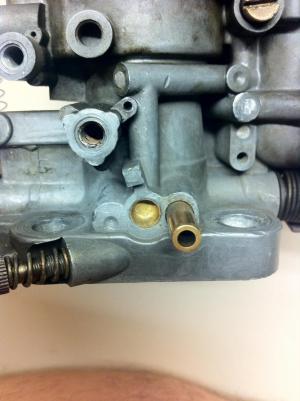
So after a week of trying to find a mischievous fuel leak from the carb. I discovered a crack in a brass plug in the idle circuit. This leak has been a nasty bitch of a thing, leaning out my idle/progressive fuel mixtures, vacuum leak, fire hazard... I swapped all the bits over to the spare weber I have. The issue is the throttle shafts are worn pretty bad so I'd like to fix this plug. Can I just drill it out and make my own plug or is it more complicated?
-
I don't even hear my facet pump. Rubber mounted in the boot and positioned so it passes air easily.
-
It's certainly a neat little rig.
-
You should use a gasket on both sides of the heat plate(insulator). You shouldn't need any vacuum hoses connected to the dizzy with that camshaft. Although the engine appears to idle smoother with manifold vacuum to the distributor, it's actually just idling faster and makes it difficult regulate idle speed. With 10 degrees base timing and the manifold vacuum on the distributor it will have about 20 degrees advance at idle. 10 degrees advance is good base timing. Idle would be ideal around 1000rpm. No higher. Possible vacuum leaks aside, I believe your biggest problem will be fuel starvation at idle. A cam with 280 advertised duration will have considerable overlap, poor compression, low vacuum and an uneven idle so keeping the keeping a rich idle mixture will help a lot.
-
Brilliant. I just spent the last hour reading up on making my own kit. I couldn't make it myself for less. Cheers Reed!
-
They're just a cheap 160mm 100w h3 lights. I had them on my ae92 seca about 8 years ago. I'm gonna swap to the Narva 150mm spot beams as soon as I can. Keeps it looking tidy. Options are quite limited with space restraints on front bumper. I'd like a spot and spread beam combination in a 6" pair but they just don't make them. Any smaller and there's no real lighting gain. Any bigger and they interfere with grill and you can't tilt them up enough. LED's are an option but the price isn't right and they just don't look the part. It's been recommended the I get the headlights on relays to brighten things up also.
-
I think they were just trying to drive me away from the recore and into buying a whole new unit from them. Just too damn expensive. On a side note, my brother bought one of those Chinese ebay alloy radiators for his patrol. It lasted 5 months before it split at one of the welds. He had a 1.1bar cap on it because the 0.9bar cap kept letting fluid out. And the radiator popped. That's what we think happened anyhow. Now he has an ADRAD.
-
I think they were just trying to drive me away from the recore and into buying a whole new unit from them. Just too damn expensive. On a side note, my brother bought one of those Chinese ebay alloy radiators for his patrol. It lasted 5 months before it split at one of the welds. He had a 1.1bar cap on it because the 0.9bar cap kept letting fluid out. And the radiator popped. That's what we think happened anyhow.
-
I was quoted $550 to recore my ke20 rad to 3 core. Just went with a ke70 ADRAD unit from ebay for 285$ from memory. It's worth upgrading the radiator cap also.
-
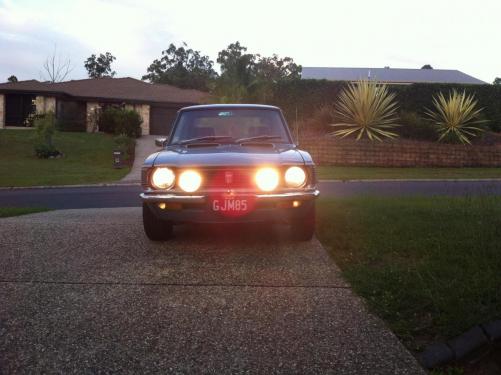
New tune. No vac advance at all. Just 10 degrees base timing. Carb is tuned with 55/55 idle, 165/160 air & 150/145 mains. Idle mixture is turns out and idle speed is 1&1/2 turns in. Idle is lumpy but relatively even with moderate manifold vacuum at 1000rpm. I think the camshaft could have been fitted with about 2 degrees advance instead of just fitting it straight up but maybe next time. Today I fitted an old set of 6" Monza spot lights I've had for years. One lense is cracked so I'm on the hunt for another set. At least the wiring is done now. With the on set of winter and dark morning runs to work on Kangaroo hazard roads I could do with the extra visibility.
 Beautiful car mate. I'm all jelly.Flywheel. You have to lighten the flywheel!Initial advance of 10* + 25* mechanical is 35* all in. If you have an initial of 18* & those 4k dizzy's have about 30* mechanical advance, your heading up to 48* all in which is likely too much. If you are getting detonation at 5000rpm you likely won't notice or hear it over the engine noise. How you determine the correct rate of mechanical advance is done through trial and error. Unless you have the correct equipment, like the shops do.I'd say it's definitely a timing issue. Though, cams with that duration need a bit more a advance earlier on and a bit less over all. For instance, my camshaft is pretty close to those specs. Static timing is 10*, it advances quickly and is all in at 35* by 3000rpm. No vac advance. Peak is about 6500rpm but it does keep going. Distributor was reco'ed & regraphed by Performance Ignition Services in Vic for $270.Toyota is funding a new cup next year utilising the new 86. It will piggy back on a number of V8 Supercar events. "Neal Bates Motorsport, owned by the four-time Australian rally champion, has developed and tested a race package that includes suspension, brakes, extractors and exhaust, ECU, oil cooler, rims and tyres as well as mandatory safety gear." http://www.toyota.com.au/news/toyota-and-v8-supercars-pro-amYes. Yes it will. It'll be a tad long though.The knock at idle is likely bottom end. Possible the big ends have bit to much side to side action on the crank journals. My set up is almost the exactly the same. I also have knock at idle that disappears once revs increase. As for the miss fire or stumble, I'd say carby and ignition timing. What carb do you run? Is you dizzy graphed to suit the camshaft?Something in regards to the electronic distributor with inbuilt ignitor. They've got two ding dangs on the vacuum advance unit On my particular distributor which is a Nippon Denso original recently rebuilt by Performance Ignitions, the dinger on top pulls 10 degrees advance and the dinger on the front pulls 15 degrees advance. Which do you use & where do you source the vacuum? Manifold or ported/timed vacuum? On a stock or slightly modified engine with good idle vacuum the vac advance unit can be used to boost take off and low end throttle response. Increasing low end torque and fuel economy at cruise speed. For this ported vacuum, also known as timed vacuum, is tapped from a lower vac port on the carburettor just above the primary throttle plate. As the throttle begins to open, engine vacuum pulls the advance unit diaphragm adding timing degrees at take off or part throttle. On highly modified engines, with larger camshaft profiles and poor idle vacuum, the vac advance unit can be used to boost idle vacuum by adding degrees to the engines idle advance. For example. An engine with a 270 advertised duration camshaft, or more, will suffer a dynamic compression loss at idle causing inconsistent and unreliable idle or engine hunting, excess engine loading and poor fuel economy. Using the vacuum advance to pull extra timing at idle will do amazing things for you. Here's the benefit of the two ding dang advance unit. I use manifold vacuum on the front stem to pull an extra 15 degrees assisting at idle, 10 degrees static +15, and I use the ported vacuum on the top stem to pull 10 degrees advance on take off and cruise assisting with throttle response and fuel economy.
 My 5k eats hyundai's all day.


